What types of braces are there?
Every set of teeth is different. Your orthodontist is the right person to determine which type of braces will best correct your teeth. On this page, we will tell you about the most common types of braces and the extent to which they are reimbursed.

What types of braces are there?
There are two types of braces: the fixed braces and the removable braces. A fixed brace is attached to the teeth. Removable braces are not fixed to the teeth. The orthodontist will determine which type of brace is most suitable for your teeth. Below is an explanation of the most common types:
Activator
The activator is a removable brace that helps with an overbite. An activator must be worn day and night and corrects an overbite by approximately one millimeter per month.
Plate brace
The plate brace is also removable. It is only suitable for simple dental corrections and is used to push crooked teeth or molars into position.
Headgear
With headgear, the growth of the upper jaw can be influenced. The outer molars are moved to create more space for the other teeth, and crooked teeth are straightened.
Braces with brackets
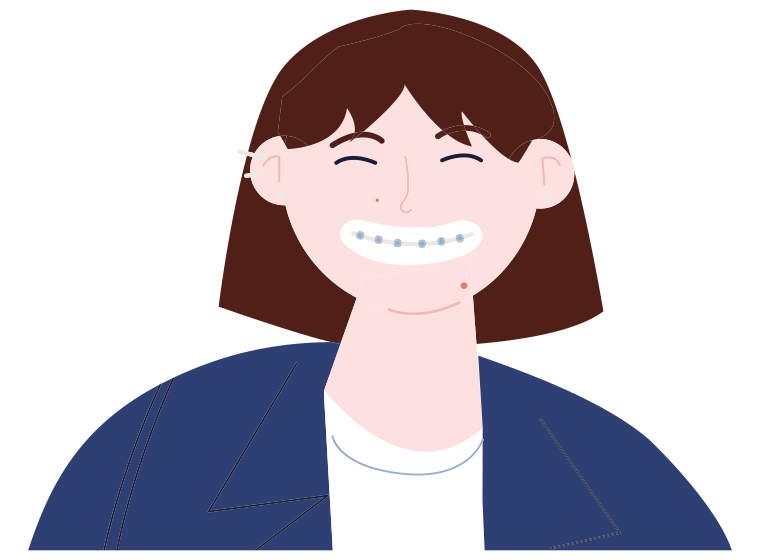
A braces system or fixed appliance places each tooth individually in the correct position. The orthodontist attaches brackets to your teeth, over which a wire is stretched. This wire ensures that your teeth move into the correct positions. The orthodontist will tighten the wire periodically.
Invisible braces
Invisible braces or lingual braces works in the same way as a fixed brace, except that the brackets are placed on the back of your teeth. As a result, the brace is not visible, but your teeth are still corrected.
Retainer
After your braces have done their job, you must wear a retainer for several months to ensure that your teeth remain straight. The frequency with which you need to wear the retainer will gradually decrease until you no longer need it. A retainer can be a wire behind the teeth, or a removable plastic night brace that you only need to wear while sleeping.
Would you like to know more?
In our free e-book, you can read more about orthodontics for teenagers.
At what age can you start with braces?
Children can start with braces as early as six or seven years old. Waiting until all the baby teeth have fallen out is not necessary. The big advantage of starting braces early is that jaw growth can still be influenced. This is no longer possible in adults. This gives children more options, and the effect of braces is often greater than in adults.
Additionally, young children usually find it less troublesome than teenagers to wear braces. Their teeth are already (mostly) straightened by the time they enter high school. Also, the statutory reimbursement for orthodontic costs is higher for children under 9 years old than for those over 9. So, starting early with braces really only has benefits.
Are you planning to start with braces? Then review these questions you can ask your orthodontist beforehand.
How much do you get reimbursed for your orthodontic costs?
For children who start before the age of 15 with orthodontics, part of the orthodontic costs is reimbursed through the statutory health insurance. Additionally, Helan customers receive a reimbursement up to €1,050. This is a 60% reimbursement for co-payments, supplements, and materials. This benefit applies to treatments from 1/1/2021 onward.
For children under the age of 9, we refer to this as 'early orthodontics'. There are different rules for reimbursement of orthodontic costs in this case. On this page, you can read more about the difference between the statutory reimbursement for early orthodontics and the statutory reimbursement for regular orthodontics.
Note: For optimal reimbursement, make sure to visit the dentist for a check-up at least once a year. Both the statutory health insurance and the supplementary dental insurance Dentalia Up reimburse more if you go for preventive check-ups annually.
Do you get more reimbursed for your braces with dental insurance?
Are you insured with the dental insurance Dentalia Up? Then you get up to €2,200 per treatment reimbursed, on top of the reimbursements from the statutory health insurance. This applies to children and teenagers who start treatment before the age of 15. The dental insurance covers 60% of the costs for braces, if you qualify for reimbursement through the statutory health insurance. On this page, you can read all the details about what Dentalia Up reimburses.
Note: Be aware of the waiting period. For orthodontics for children, there is a 12-month waiting period. We recommend that parents of young children enroll early in the dental insurance. This way, you will be optimally insured when your child needs braces. If you enroll in Dentalia Up before your child turns 5, you will benefit from the maximum reimbursement.

Looking for an answer to your questions?
Do you have a question about the Dentalia Up dental insurance? We are happy to assist you. You can find answers to the most frequently asked questions on our FAQ page. You can also contact our customer advisors through various channels. Together, we will review your question or situation.
Read more about dental insurance

Helan Independent Health Insurance Fund is the insurance agent (n° CDZ 5006c) for ‘MLOZ Insurance’, the VMOB of Independent Health Insurance Funds, (Register of Legal Entities in Brussels, 422.189.629, recognised under no. CDZ 750/01 for branches 2 and 18). View the data sheet and the General Terms and Conditions. Belgian law applies to the insurance contract. The term of the contract is whole life. In the event of any complaint, contact the complaints department of Helan Health Insurance Fund or the insurance ombudsman. For more information about purchasing this/these product(s), please contact Helan Health Insurance Fund. Helan Onafhankelijk ziekenfonds, Boomsesteenweg 5, 2610 Wilrijk, 0411.696.011, RPR Antwerpen, www.helan.be.